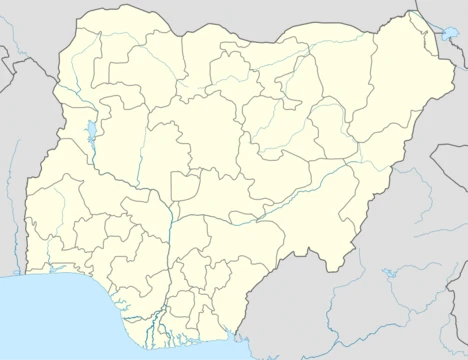
Ebonyi State
A southeastern Nigerian state formed in 1996 from Abia and Enugu.

via Wikipedia: Ebonyi State · see source
Ebonyi (Igbo: Alaọha Ebonyi) is a state in the South-East geopolitical zone of Nigeria, bordered to the north and northeast by Benue State, Enugu State to the west, Cross River State to the east and southeast, and Abia State to the southwest. Named after the Abonyi (Aboine) River—a large part of which is in the state's south—Ebonyi State was formed from parts of Abia and Enugu state in 1996 and has its capital in Abakaliki. One of the smallest states of Nigeria, Ebonyi is the 33rd largest in area and 29th most populous with an estimated population of nearly 2.9 million as of 2016.
- created
- 1996
- capital
- Abakaliki
- area_rank
- 33rd largest in area
- population_estimate_2016
- nearly 2.9 million
- geopolitical_zone
- South-East geopolitical zone
- named_after
- Abonyi (Aboine) River
- human_development_index_rank
- joint-twentieth highest
Verified Timeline
Lore & Background
After independence in 1960, the area of present Ebonyi was a part of the post-independence Eastern Region until 1967 when the region was split and the area became part of the East Central State. Less than two months afterwards, the former Eastern Region attempted to secede in the three-year long Nigerian Civil War with Ebonyi as a part of the secessionist state of Biafra. At the war's end and the reunification of Nigeria, the East Central State was reformed until 1976 when the state's north became Anambra State and the south became Imo State. Fifteen years afterwards, Anambra and Imo states were divided with their eastern parts becoming Enugu State and Abia State, respectively. It was not until 1996, when Enugu State's east and Abia's northeast were split off and joined to form Ebonyi State. It was one of the six states created in 1996 by the then federal military government of General Sani Abacha. The state has three senatorial zones: the Abakaliki division make up Ebonyi North and Ebonyi Central senatorial zones, while the Afikpo, Edda, Ohaozara, Onicha and Ivo division make up the Ebonyi South senatorial zone. Ebonyi has thirteen local government areas.
Reader's Guide
Economically, Ebonyi State is based around agriculture, mainly of yams, rice, oil palm, and cassava crops. A key minor industry is mining due to lead, zinc, and limestone deposits around Abakaliki, and locally hand-made baskets of various sizes at Ntezi. Ebonyi is called 'the salt of the nation' for its huge salt deposit at the Okposi and Uburu Salt Lakes. The state has invested in infrastructure, including the Ebonyi State International Airport, built on the Abakaliki end of the Abakaliki-Afikpo Expressway, and 23 flyovers, the highest in South East Nigeria. Ebonyi state is known for its trademark concrete roads and multicolored infrastructure, began by former governor Dave Umahi. Politically, in 1999, Dr. Sam Ominyi Egwu was elected as the first governor of the state under the People's Democratic Party (PDP). He was succeeded by Martin Elechi who was elected in 2007 and successfully ran for re-election in 2011, under the same PDP. Gov Martin Elechi was succeeded by Governor Dave Umahi, who was elected in the March 2015 election and re-elected in March 2019 for a second term in office. During his second tenure, Governor Dave Umahi defected to All Progressive Congress (APC) just prior to the 2023 General elections. His new party (APC) subsequently produced the Governor that succeeded him, Governor Francis Ogbonna Nwifuru, whose first tenure will elapse on May 29th, 2027. Ebonyi has the joint-twentieth highest Human Development Index in the country and numerous institutions of tertiary education.
Did You Know?
- Ebonyi State was formed from parts of Abia and Enugu states in 1996 by the federal military government of General Sani Abacha.
- The state is named after the Abonyi (Aboine) River, a large part of which is in the state's south.
- Ebonyi has 23 flyovers, the highest number in South East Nigeria.
- The state is called 'the salt of the nation' for its huge salt deposit at the Okposi and Uburu Salt Lakes.
- Ebonyi has the joint-twentieth highest Human Development Index in the country.
Frequently Asked Questions
Who is Ebonyi State?
Ebonyi is a compact state in Nigeria's South-East geopolitical zone, established in 1996 by carving territory out of Abia and Enugu. Its capital is Abakaliki, and the state takes its name from the Abonyi (Aboine) River that flows through the region.
What are Ebonyi State's powers or role?
The state functions mainly as an agricultural engine for the South-East, producing yams, rice, oil palm, and cassava at scale. It also holds underground deposits of lead, zinc, and limestone that give it a secondary industrial identity.
How does Ebonyi State's story end?
Because Ebonyi is a living political entity rather than a fictional narrative, it has no fixed ending — it simply continues as one of Nigeria's 36 states. Its ongoing story is shaped by agricultural output, population growth, and the pace of its mining sector's development.
Why is Ebonyi State important?
Though it ranks 33rd in area and 29th in population (roughly 2.9 million people as of 2016), it punches above its size in feeding the South-East zone. Its mineral reserves also position it as a potential contributor to Nigeria's broader industrial supply chain.
Where did Ebonyi State come from?
It was formally created in 1996 by splitting land from both Abia and Enugu states. The name honours the Abonyi River, a long-standing geographic landmark that gave the surrounding communities their identity long before the state existed.
More in Nigerian States 1-24
Related in Nigerian States
Links follow this subject's own source article.
Elsewhere in the Nigerian States universe
Spotted an error? Know more?
This is a living reference — every entry is fact-audited, and reader corrections feed straight into our audit queue. Suggest an edit · See this site's audit record